In most art, the sad but true reality exists that a lot of artists only get famous and recognized (sometimes long) after they die. Big names like Vincent van Gogh, Johannes Vermeer and Claude Monet had a lot of difficulty selling their art at the time they lived. And in the case of Monet, when he was still in art school, many of his now famed works were criticized harshly! The result of this was that many of the names we now associate with art collections and million dollar auctions, lived modest and for some even impoverished lives.
But we have come a long way since then. As confirmed in May 2019, when the record for most expensive work of art by a living artist was broken. The piece of art in question is Jeff Koons’ Rabbit (1982):

The huge amount of money for which it was auctioned made me interested in the story and the way art gets its value. A lot of the value in art is in the authenticity and historical value of the art piece. Which explains the fact that most art only gets really valuable a long time after it has been made. Only then can be realized what impact the piece had on the culture.
But the record breaking auction of a piece from 1982 made me wonder: maybe the valuation of art is changing? I have gathered some data about the development of record auctions of pieces by living artists:
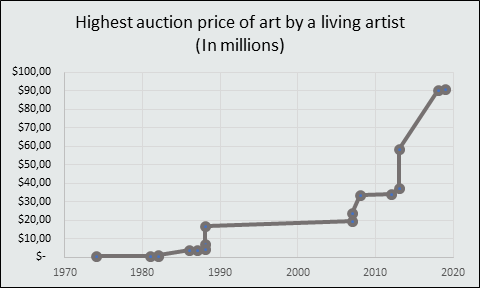
As you can see from the data, there was a slight uprising from 1980 to 1990, after which the records stagnated. Until 2007, from which on more records started happening again. The value for which the works get auctioned also increased greatly, from $ 350 000 in 1981 to $ 91.1 million in 2019.
These developments could mean that there is a bigger interest in more recent art again. The historical value might be less important to collectors these days. Or collectors acknowledge historical value after a shorter period of time than they would do for works in the past. These are questions you could ask yourself: How high would you value the historical value of an art piece? And when is a piece historically relevant?
It is hard to say what the exact cause of these developments is. But as it stands, this is a great development for the living influential artists of our time, and them getting the recognition they deserve. Whether we discover every influential artist in time remains a challenge though, and I hope we will not have cases like van Gogh, Vermeer or Monet in our years onwards.
Sources:
http://www.essentialvermeer.com/vermeer_the_man.html#.XW5jKegzZPY
https://www.sothebys.com/en/series/the-value-of-art
Data sources:
https://www.bbc.com/news/entertainment-arts-22538258
https://www.nytimes.com/2008/05/19/arts/design/19arts-THEMYSTERYAR_BRF.html
http://www.artnews.com/2007/11/26/sothebys-scores-its-highest-ever-316m-contemporary-auction/
http://www.artnews.com/2007/10/01/the-branding-of-damien-hirst/
https://www.nytimes.com/1988/11/10/arts/johns-s-white-flag-is-sold-for-record-price.html
https://www.nytimes.com/1988/05/09/arts/buyer-of-johns-painting.html
https://www.nytimes.com/1987/05/05/arts/de-kooning-painting-ties-auction-record.html
https://www.nytimes.com/1986/11/11/arts/jasper-johns-painting-brings-record-price.html
http://search.ebscohost.com/login.aspx?direct=true&db=f6h&AN=54225488&site=ehost-live
https://www.nytimes.com/1982/03/31/arts/dali-s-mere-sets-auction-record.html
https://www.nytimes.com/1981/06/07/arts/auctions-art-records-set-in-may.html
 Making sense of art and design industries